Standard Petrol vs. E20 Engine: The Real Price Difference You Must Know
Same Price, Less Mileage? The E20 Fuel vs Standard Petrol Truth Companies Aren’t Telling You
As India accelerates toward the 20% ethanol blending target (E20), automakers are rolling out “E20-ready” vehicles. While the environmental benefits are clear, a pressing question lingers in every buyer’s mind: How much extra does this “green” hardware cost?
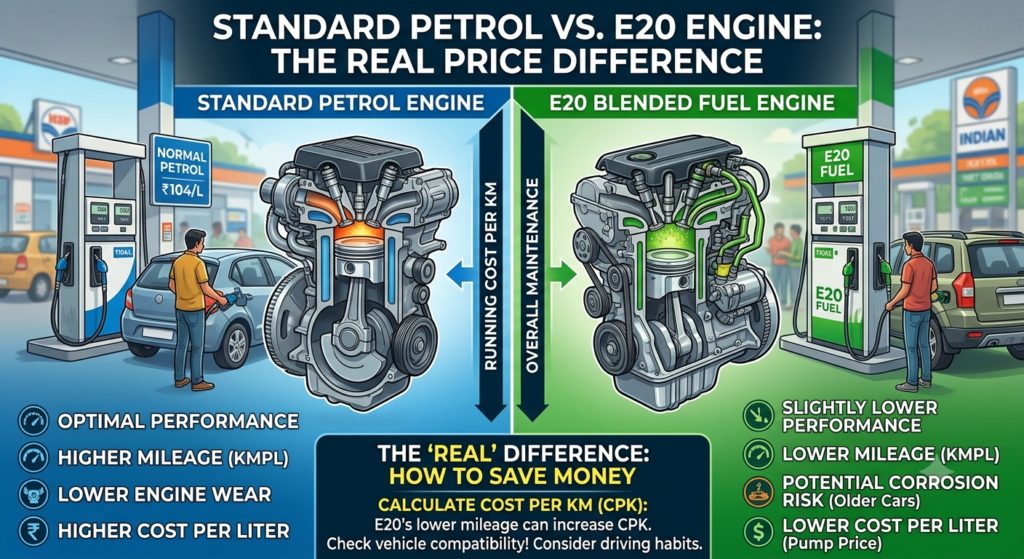
At first glance, an E20 car and a standard petrol car look identical. However, the price difference is not just a marketing gimmick; it is rooted in expensive metallurgy, advanced electronics, and complex manufacturing processes. Here is a detailed breakdown of why an E20 engine costs more, both at the showroom and at the service station.
1. The Manufacturing Cost: Why E20 is Pricier to Build
To withstand ethanol’s corrosive nature and higher compression ratios, manufacturers must replace standard components with premium, “hardened” ones. This significantly impacts the Bill of Materials (BOM).
| Component | Standard Petrol Engine Cost | E20-Compliant Engine Cost | Reason for Price Hike | |
| Fuel Pump | Base copper windings | Silver-plated/Coated windings | +30% to 40% | Prevents electrochemical corrosion from ethanol. |
| Fuel Lines & Seals | Standard Nitrile Rubber | FKM (Fluoroelastomer) / Teflon | +50% to 60% | Must resist swelling and cracking caused by acidic ethanol. |
| Valve Seats | Cast Iron or Soft Steel | Hardened Sintered Alloy | +25% | Prevents valve recession under higher combustion pressure. |
| Piston Rings | Standard Cast Iron | Chromium-Ceramic coated | +35% | Ethanol washes oil away; needs anti-friction coatings. |
| Cylinder Bore | Standard Cast Iron Liner | Ni-SiC (Nickel-Silicon-Carbide) coating | +40% | Ultra-hard surface to resist abrasive wear. |
| ECU & Sensors | Standard O2 sensor | Flex-Fuel sensor + Advanced Lambda logic | +20% | Needs to detect ethanol content and adjust fuel maps in real-time. |
Estimated Manufacturing Cost Increase:
Industry experts (including SIAM) estimate that making an engine fully E20-compliant adds roughly ₹5,000 to ₹8,000 ($60–$100) to the production cost of a small hatchback. For larger SUVs with more powerful engines and complex high-pressure direct-injection systems, this premium can go up to ₹12,000 to ₹15,000.
2. Showroom Price Impact (Ex-Showroom)
How does this translate to the buyer’s wallet?
Mass-Market Cars (e.g., Maruti Suzuki WagonR, Hyundai i10):
The ex-showroom price of an E20-compliant variant is typically ₹5,000 to ₹10,000 higher than its older BS6 (Stage 1) standard petrol sibling.
Premium & SUV Segment (e.g., Toyota Innova, Mahindra XUV700):
The price gap widens to ₹15,000 to ₹25,000 due to larger fuel tanks, high-pressure fuel rails, and more sophisticated engine control modules.
Important Note:
Many manufacturers are absorbing a portion of this cost by offering E20 compliance as a standard update across their lineup rather than a separate “optional” variant. However, if you compare a 2021 standard petrol model to a 2025 E20 model, you will notice a clear upward price revision.
3. The Real Killer: Spare Parts & Maintenance Costs
The price difference does not end at the showroom. When you visit the service center for repairs or replacements, the cost disparity becomes stark.
Fuel Injectors:
A standard injector might cost ₹2,500. An E20-specific injector with anti-corrosion needle valves can cost ₹3,500–₹4,000.
Fuel Pump Assembly:
Standard units are often under ₹4,000; E20-compliant pumps with silver plating can cross the ₹6,000 mark.
Rubber Hoses:
A standard radiator or fuel hose is cheap (₹500). FKM-grade replacement hoses are often double the price due to their specialized chemical resistance.
Service Interval Impact:
Because ethanol can dilute engine oil and attract moisture, E20 engines often require slightly shorter oil change intervals (or specific low-ash oils). This results in an estimated 5% to 10% increase in annual maintenance costs compared to a standard engine.
4. The Fuel Cost Trade-Off (Running Expenses)
Here is the twist: While the car itself is more expensive, what about the fuel?
Price per Liter:
E20-blended petrol (20% ethanol) is generally cheaper than 100% unblended petrol because ethanol is subsidized and costs less than crude-derived gasoline. Typically, ethanol-blended fuel is ₹2 to ₹3 cheaper per liter.
The Mileage Catch:
Ethanol has a lower energy density than petrol. This means to produce the same amount of power, the engine must inject more fuel. On average, E20 fuel reduces fuel efficiency by 6% to 7%.
The Math (Example):
Despite the cheaper fuel, the lower mileage means the running cost per kilometer increases slightly for the E20 vehicle. You might save money at the pump but lose it on the road.
5. Is the Premium Worth It?
Here is the verdict on the price difference:
| Factor | Standard Petrol Engine | E20-Compliant Engine | Winner |
| Upfront Cost | Lower (Base price) | Higher (+₹5k to ₹25k) | Standard |
| Spare Part Cost | Cheaper to replace | 20-40% expensive to replace | Standard |
| Fuel Price | Normal Petrol (Costly) | E20 (Cheaper per liter) | E20 |
| Fuel Efficiency | Better mileage | ~6-7% lower mileage | Standard |
| Future-Proofing | Risk of damage if E20 is forced | Safe and legal (Mandate compliant) | E20 |
Final Verdict
Buying an E20 engine is not a cost-saving decision—it is a necessity for the future. The government mandates that by 2026, only E20-compliant vehicles will be sold.
You are paying a premium of roughly 1% to 2% of the vehicle’s on-road price for hardened hardware that ensures your engine doesn’t corrode or fail within three years. While the spare parts are more expensive and the mileage is slightly lower, the alternative—running a standard engine on E20 fuel—could lead to catastrophic fuel leaks and engine seizures, costing you ₹50,000+ in repairs.
In short: You pay more upfront to save your engine’s life later. When buying a new car today, the price difference is a worthy investment in reliability and regulatory compliance.