In India, the government’s ambitious target to achieve a 20% ethanol-blending rate (E20) by 2025 has forced automakers to rethink engine design. While the fuel itself is a blend of 20% ethanol and 80% petrol, the hardware required to burn it safely and efficiently is drastically different from a standard internal combustion engine (ICE).
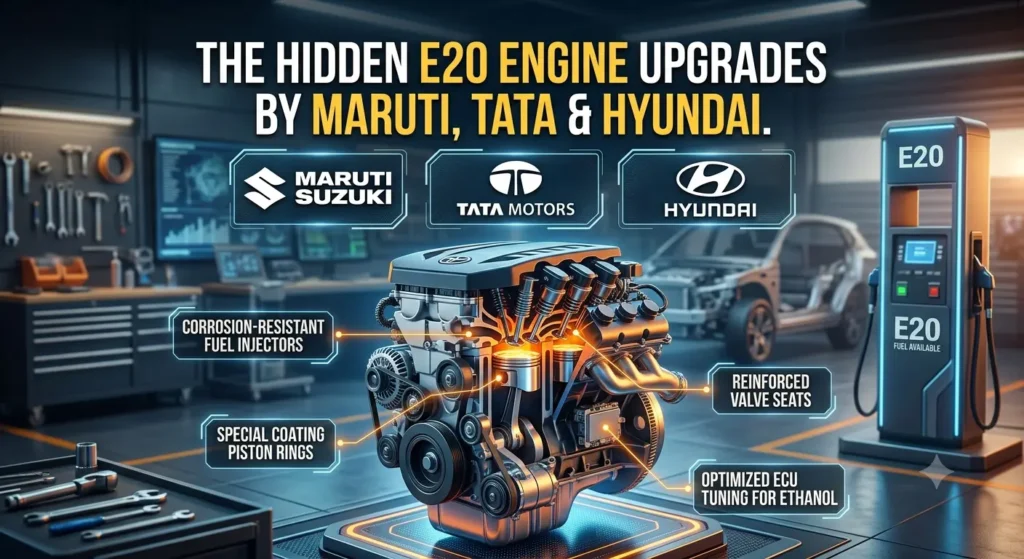
At first glance, an E20 car looks identical to its petrol counterpart. However, pop the hood, and you will find a suite of hardened components, sophisticated sensors, and redesigned fuel pathways. Here is a deep dive into the specific hardware differences that set an E20 engine apart from a normal engine.
1. The Fuel System: Corrosion is the Enemy
The most significant difference lies in the fuel delivery system. Ethanol is highly corrosive and acts as a solvent. It can degrade standard rubber and plastic components, leading to fuel leaks and performance loss.
Fuel Pumps & Injectors:
Standard fuel pumps often use copper or brass windings. In an E20 engine, these are replaced with silver-plated or coated components to prevent electrochemical corrosion. Fuel injectors are precision-engineered with tighter tolerances and feature anti-corrosion needle valves.
Fuel Lines:
Regular rubber hoses are replaced with Fluoroelastomer (FKM) or Teflon-lined hoses. These materials are resistant to the acidic nature of ethanol and prevent swelling or cracking.
Fuel Filters:
Ethanol acts as a detergent, loosening dirt and varnish from the fuel tank. E20 cars are equipped with high-capacity fuel filters to catch this increased debris load, preventing clogging of the injectors.
2. The Engine Block and Valvetrain: Harder, Stronger
Ethanol burns differently than petrol. It has a higher octane rating (around 100 RON) but a lower energy density. To handle the increased combustion pressure and the corrosive byproducts of ethanol combustion, the core mechanicals must be upgraded.
Valves and Valve Seats:
In standard engines, valve seats are often made of cast iron or soft steel. Ethanol combustion produces water vapor and acids. To prevent valve recession (erosion of the valve seat), E20 engines utilize hardened steel or sintered alloy valve seats.
The intake and exhaust valves are often Nitrided (a heat-treatment process) to increase surface hardness.
Pistons and Rings:
The piston rings in an E20 engine feature a hard chromium or ceramic coating. This is necessary because ethanol can wash the oil film off the cylinder walls more aggressively than petrol, increasing friction. The top piston ring groove is often anodized to prevent micro-welding under high heat.
Cylinder Liner:
Manufacturers often use a Nickel-Silicon-Carbide (Ni-SiC) coating on the cylinder bores. This “boring” is harder than traditional iron liners and resists the abrasive wear caused by the “cold start” richness of ethanol blends.
3. The Combustion Chamber: Higher Compression
Ethanol has a Research Octane Number (RON) of ~100, compared to standard petrol’s ~91. This means it resists “knocking” (detonation) much better. To exploit this property, E20 engines are physically redesigned for higher efficiency.
Higher Compression Ratio:
A normal petrol engine typically runs a compression ratio of 9.5:1 to 10.5:1. E20-specific engines often push this to 11.5:1 or even 12:1. To accommodate this, the cylinder head geometry is redesigned.
Piston Top Design:
The piston crown is reshaped (often with a central bowl) to direct the fuel spray for optimal tumble and swirl, ensuring the higher compression doesn’t cause pre-ignition and that the fuel-air mixture is homogeneous.
4. Thermal Management: Keeping the Cool
Ethanol has a higher latent heat of vaporization. When injected, it evaporates and cools the intake air significantly. While this reduces the risk of knocking, it creates issues with “cold startability” and condensation.
Revised Cooling Jackets:
E20 engines often feature revised water jackets around the cylinder head to ensure the block reaches operating temperature faster, compensating for ethanol’s cooling effect.
Enhanced Oil Coolers:
Because ethanol combustion produces slightly higher exhaust temperatures, E20 cars are often fitted with larger or more efficient oil coolers to keep the engine lubricant from shearing under the increased thermal load.
5. Sensors and Electronics: The Brain Upgrade
Modern E20 engines rely heavily on “Flex-Fuel” sensor technology, though the implementation varies:
Ethanol Content Sensor
(Fuel Composition Sensor) Some high-end E20 cars feature a sensor in the fuel line that measures the dielectric constant of the fuel. It sends a signal to the ECU (Engine Control Unit) to adjust the air-fuel ratio instantly. In cars without this sensor, the ECU relies on the O2 Sensor (Lambda sensor) to detect the fuel change and adjust the injector pulse width.
High-Pressure Fuel Pumps:
To push the denser ethanol mixture through the injectors, E20 engines utilize high-pressure fuel pumps that can operate at pressures exceeding 350 bar (compared to ~200 bar in standard port-injection engines).
6. Exhaust System: Tougher Steel
The acidic nature of ethanol combustion byproducts doesn’t stop at the engine block; it extends to the exhaust system.
Exhaust Manifolds:
Standard stainless steel may suffice, but E20 engines often use austenitic stainless steel (e.g., 304L or 409L) which has higher chromium and nickel content to resist the chemical attack from the acidic exhaust condensate.
Catalytic Converters:
The washcoat inside the catalytic converter is adjusted to handle the higher volume of aldehydes and unburnt hydrocarbons produced by ethanol combustion.
Summary Table: E20 vs. Normal Engine Hardware
| Component | Standard Petrol Engine | E20-Compliant Engine |
| Fuel Lines | Standard Rubber/Nylon | FKM (Fluorocarbon) or Teflon Lined |
| Fuel Pump | Copper Windings | Silver-Plated/Coated Windings |
| Valve Seats | Cast Iron / Soft Steel | Hardened Sintered Alloy |
| Piston Rings | Standard Cast Iron | Chromium-Ceramic Coated |
| Compression Ratio | ~9.5 – 10.5:1 | ~11.5 – 12:1 |
| ECU Calibration | Fixed for Gasoline | Adaptive (Flex-Fuel logic) |
| Exhaust Material | Standard 400 Series Steel | High-Chromium 300 Series Steel |
| Spark Plugs | Standard Heat Range | Cold Type (higher heat dissipation) |
The Bottom Line
Upgrading to E20 is not a simple bolt-on modification; it is a holistic hardware overhaul. While ethanol offers the benefit of higher octane and lower emissions, it demands a “tougher” engine. Manufacturers like Toyota, Honda, and Maruti Suzuki have invested heavily in “Ethanol-Compatible” hardware, utilizing nickel-plated fuel tanks, coated pistons, and advanced anti-knock sensors.
For consumers, the shift means that while you can fill an E20 car with normal petrol, you cannot generally fill a standard old car with E20 fuel without risk of fuel leaks, injector clogging, and long-term engine seizure. The hardware inside an E20 engine is built not just to run, but to survive.