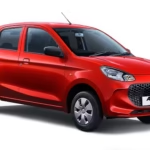
Renault India has launched the Triber Turbo at Rs 7.84 lakh (ex-showroom), finally giving its sub-four-metre seven-seater a turbocharged petrol option. The new version moves to Renault’s RGEP platform, but the body, design and cabin are carried over unchanged from the outgoing Triber.
Power comes from a 1.0-litre, three-cylinder TCe turbo-petrol engine paired to a five-speed manual gearbox, and Renault claims a mileage of 21kmpl. Here is everything you need to know, along with our first drive impressions.
- Triber Turbo is priced from Rs 7.84 lakh, a Rs 1.11 lakh premium over the respective naturally aspirated versions
- New 1.0-litre turbo-petrol makes 99bhp and 180Nm, with a claimed 21kmpl
- Sits on the new RGEP platform; design, cabin and features remain the same
Renault Triber Turbo Price & Variants –
The Triber Turbo is offered in three variants, all with a manual gearbox:
| Variant | Price (ex-showroom) |
| Triber Turbo MT Evolution | Rs 7.84 lakh |
| Triber Turbo MT Techno | Rs 8.53 lakh |
| Triber Turbo MT Emotion | Rs 8.99 lakh |
All prices ex-showroom
- The turbo range starts at Rs 7.84 lakh, which is Rs 1.11 lakh more than the respective naturally aspirated version.
- There is no automatic option yet; Renault has not confirmed other versions.
What Is New On The Triber Turbo? –
Renault had earlier said the old platform could not accommodate a turbo-petrol engine, which is why this version rides on the new Renault Group Entry Platform (RGEP). Along with the engine, the carmaker has made several changes under the skin:
- Revised suspension tuning and anti-roll bars
- New thermal management system
- Structural enhancements
- Better braking performance
- Revised settings for ABS, traction control (TCS) and vehicle dynamic control (VDC)
Powertrain Options –
| Specification | Triber Turbo |
| Engine | 1.0-litre, 3-cylinder TCe turbo-petrol |
| Power | 99bhp |
| Torque | 180Nm |
| Transmission | 5-speed manual |
| Claimed mileage | 21kmpl |
Renault says 21kmpl is the best in the segment. The carmaker has not shared the RPM at which peak power and torque arrive. CNG and CVT versions are expected in the near future, but Renault has not confirmed either.
Design –
There are no exterior changes at all, as the Triber Turbo keeps the same top-hat as the current car. The front end gets a sculpted bonnet, a blacked-out grille and triangular inserts above the squared-off fog lamps, which give it a muscular look.
- Black roof rails, ORVMs, door handles, and B- and C-pillars
- 15-inch steel wheels with stylish wheel covers that look close to alloys
- Two-piece wraparound LED taillamps, black tailgate applique and a 3D Renault logo
- A blacked-out ‘Turbo’ badge at the rear is the only visual clue to the new engine
Interior –
The cabin is unchanged, too. It retains the dual-tone beige and black theme, with a grey and silver honeycomb texture on the dashboard. Plastic quality is good for the price, and the honeycomb theme continues on the seats, which get contrast white stitching.
The rotary knobs and centre-console buttons feel solid. However, the unusual placement of the engine start-stop and cruise control buttons takes some getting used to.
Features & Safety –
Renault has not added any new features to the Triber Turbo. The equipment list carries over as is:
- Large freestanding touchscreen with Apple CarPlay and Android Auto
- Digital, coloured instrument cluster and wireless charger
- Cruise control, height-adjustable driver seat and one-touch driver-side window
- Cooled armrest storage and two glove boxes in the front
- Reverse parking camera and six airbags
- Second row: AC vents with blower control, 12V charging port, 80:20 split seats with slide and recline, and a one-touch tumble function for third-row access
- Third row: 12V charging port and two cubby holes
Space & Practicality –
Despite measuring under four metres, the Triber is still one of the most space-efficient cars in its class. Front-row storage is generous, with a cooled compartment at the end of the centre console, and the door pockets take one-litre bottles.
- Second row: good legroom and decent headroom for an average-height Indian, though three abreast will be tight at the shoulders
- Third row: reasonable legroom and shoulder room for the size, though headroom is average and getting in and out depends on your agility
- Boot: with the third row up, there is room for a duffle bag or light backpack, but not the smallest suitcase
- Boot with third row folded or removed: 625 litres, enough for five people and their luggage
Performance & Driving Impressions –
The turbo makes a clear difference. Low-end torque is noticeably stronger, and the Triber can even spin a wheel in second gear if driven hard. The engine has been retuned for better low-end and mid-range response, so city driving needs far fewer downshifts than with the naturally aspirated motor.
It can also crawl over speed breakers in third gear without fuss and stays quick with two people and luggage on board. Braking has improved as well, which was evident during a few sudden stops.
Ride, Handling & NVH –
- Ride stays pliant and absorbs speed breakers and bumps well up to about 60-80kmph, after which it feels a little stiffer.
- Body roll is still significant despite the new anti-roll bars, and the car feels unsettled at higher-than-average speeds.
- Steering is light and offers very little feedback.
- The typical three-cylinder thrum is audible in lower gears at city speeds, and vibrations are felt around the footwell.
Renault Triber Turbo Test Drive Ratings –
| Parameter | Rating |
| Exterior design | 8 / 10 |
| Interior design | 7.5 / 10 |
| Features | 7 / 10 |
| Space and storage | 8.5 / 10 |
| Performance | 8 / 10 |
| NVH | 6 / 10 |
| Overall verdict | 8.5 / 10 |
Pros & Cons –
Why would you buy it?
- Practicality
- Impressive performance
Why would you avoid it?
- Fit and finish
- No automatic transmission
Rivals –
Renault has not named direct competitors for the Triber Turbo. With three rows in a sub-four-metre body, it has few direct rivals, but if you are simply after a turbo-petrol car at this price, the Renault-Nissan sibling Nissan Magnite is worth checking, while buyers who want a bigger seven-seater can look at the Maruti Ertiga.
Verdict –
The Triber always needed a turbo, and it should have arrived from day one. Better late than never, though. At Rs 7.84 lakh, the extra Rs 1.11 lakh over the naturally aspirated version is a considerable jump, but the package justifies it: three rows of seats in a compact body, a healthy feature list, a pliant ride and now enough power to carry a fully loaded car.
With automatic and CNG versions likely to follow, the Triber is becoming an even stronger proposition.
What are your thoughts on the Renault Triber Turbo? Let us know in the comments below!