Review Tata Nexon –
The Tata Nexon is Tata’s first attempt at cracking the sub-4 meter segment, and it is making headlines for all the right reasons. It became the first made-in-India car to score a full 5-star safety rating in Global NCAP crash tests. The Tata Nexon is also the only sub-4 meter SUV to offer an optional automatic transmission with both its petrol and diesel engine options.
It competes with the Maruti Suzuki Vitara Brezza, Ford EcoSport, and Mahindra XUV300. The Tata Nexon brings a funky and adventurous design, a comfortable, feature-packed cabin, and a choice between a 1.2-litre turbo-petrol or a 1.5-litre turbo-diesel engine—both available with either a 6-speed manual transmission or a 6-speed AMT. Does it come together as a complete package compelling enough to be chosen over its competition?
The Nexon is a fantastic value proposition and feels like a step forward for the segment. It is a very well-rounded car that offers a great balance of safety, features, style, comfort, and practicality. The diesel engine, in particular, is a major draw for the Nexon as it offers excellent tractability and performance.
While the diesel engine paired with either the 6-speed manual or AMT is a great drive, on the petrol side, we recommend the AMT over the manual. The 3-cylinder petrol engine has some issues with turbo-lag, and the tuning of the automated manual transmission makes driving around it much more hassle-free.
Tata Nexon Exterior –
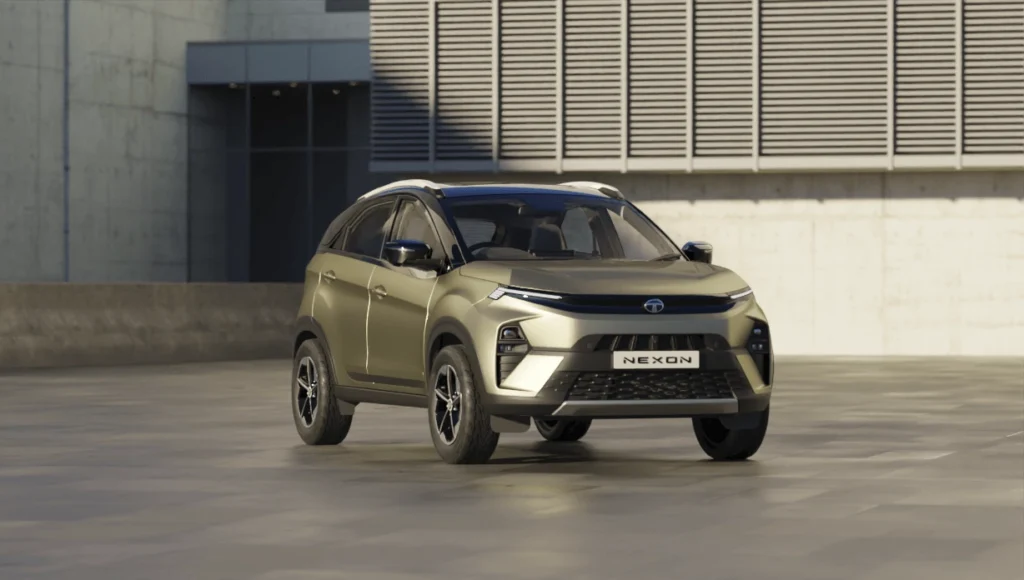
The Tata Nexon is truly a crossover, combining hatchback-like styling with the tough design cues of a sub-compact SUV. In this sense, it is similar to the Ford EcoSport, in contrast to the boxier Maruti Suzuki Vitara Brezza or Mahindra XUV300. The Nexon’s SUV traits include its ground clearance, which at 209 mm is comparable to the Renault Duster, along with large 16-inch wheels.
The unconventional design is pleasing to the eye. The top-spec XZ+ variant of the Nexon features a contrast-colored roof in Steel Grey alongside red, blue, and orange exterior body colors. An off-white plastic trim runs along the side just below the greenhouse. This continues to the rear, though it is plastic rather than paint. Tata could have done without it, but they could have overdone it too—which they haven’t. On the orange body paint, this strip shares the same color as the roof.
Dimensions & Weight –
| Specification | Measurement |
| Overall Length | 3994 mm |
| Overall Width | 1811 mm |
| Overall Height | 1607 mm |
| Wheelbase | 2498 mm |
| Ground Clearance | 209 mm |
| Kerb Weight | 1250 kg |
Apart from the grey roof and off-white sash, there is another contrasting element on the outside—black plastic cladding. This gives the Nexon a rugged, raised stance.
Look straight into the Nexon’s eyes, and you will see hints of Tata’s ‘Impact’ design language. The top line of the front grille extends into the pulled-back projector headlamps. In Tata lingo, this is the ‘Humanity Line.’ However, the Nexon’s design looks more aggressive than its siblings. Elements adding to the bold front look include LED daytime running lamps, high-set fog lamps, a wide front air intake, and flared wheel arches.
While the Nexon looks SUV-ish from the front, the rear is more hatchback-like. The high ground clearance is hard to miss, and the stock tires (215/60 R16) look wide for a vehicle of the Nexon’s size. A faux skid plate on the rear bumper adds a bit of ruggedness.
There is an off-white and glossy black element around the clear-lens taillamps that adds quirkiness to the design. We have been seeing the Nexon around since 2017, but these small nuances ensure that it still looks offbeat.
Nexon Interior –
Design, Quality, Fit & Finish, Usability, and Equipment
The Nexon’s interior consists of three main layers. The upper section is finished in dark grey plastic, and its quality is on par with its rivals. The middle layer gets an aluminum finish and looks particularly upmarket; the thickness and solid feel of this layer throughout the cabin make you feel like you are sitting in a higher-segment car. The third and lowest layer is a plastic in a greyish shade of beige. This plastic is hard to the touch, and the fit and finish levels here aren’t very high.
For example, closing the glovebox requires more than one attempt, and the fit on the lower door panels feels questionable, especially around the edges. These two are probably the only touchpoints where fit and finish feel compromised. Otherwise, Tata has managed to do a good job of ensuring satisfying quality levels at key touchpoints.
Sitting atop the Nexon’s dashboard is a 6.5-inch Harman infotainment system fixed in place. It’s impossible to miss, and more importantly, it feels high-quality and well-thought-out. The display remains crisp and readable even under bright sunlight; only the rearview camera feed looks slightly grainy—though that is more down to the camera output than the screen itself.
The touchscreen isn’t the most intuitive, and there is a slight lag every time you operate it. However, it doesn’t drop inputs too often. Response times are faster when using the physical buttons and knobs, which Tata has placed well within reach for easy operation on the move.
While the touchscreen infotainment system was available only with Android Auto at launch, models sold from August 2018 onwards also include Apple CarPlay. Owners who bought their car earlier can update their system through a service center to enable Apple CarPlay support. The driver-side instrument cluster is simple in design, featuring a multi-information display (MID) between the speedometer and tachometer. It provides standard readouts like two trip meters, average fuel efficiency, distance-to-empty, and more.
The center console extends from below the central AC vents all the way to the rear. Along with the automatic climate control knobs, it houses USB and AUX ports and a drive-select knob. It also features a pair of cup holders that can be closed with a tambour door—a roller shutter mechanism usually seen on higher-end cars.
The cubby hole is an ergonomic misstep: it is too deep and cramped to comfortably store or retrieve cups. Moving further back, a small storage compartment opens up with enough space to hold your smartphone and wallet; ideally, this is where the USB and AUX sockets should have been located. The central armrest extends towards the rear cabin and includes air conditioning blowers for rear passengers.
Nexon Cabin –
The Nexon’s cabin is comfortable enough to deserve a special mention. To be clear, the Nexon is best suited as a four-seater. Saying this doesn’t mean the cabin isn’t spacious, but rather that the rear seats are contoured that way. While you get a bench in the rear, the seats feature properly sculpted bucket contours for two passengers if you intend to carry a third person.
Capacity –
| Feature | Details |
| Seating Capacity | 5 |
| Number of Seating Rows | 2 Rows |
| Number of Doors | 5 Doors |
| Boot Space | 350 litres |
| Fuel Tank Capacity | 44 litres |
When seating three at the back, the Maruti Vitara Brezza fares slightly better, offering 1400 mm of shoulder room compared to the Nexon’s 1385 mm. At 1220 mm, the Nexon’s seat base is also narrower than the Vitara Brezza’s (1300 mm). However, with only two occupants in the rear row, the Tata Nexon proves more comfortable. It offers 20 mm more headroom than the Vitara Brezza and superior knee room—715 mm to 905 mm versus Maruti’s 625 mm to 860 mm.
Step into the front seat of the Nexon, and you are greeted by excellent comfort. With 965 mm to 1020 mm of headroom at the driver’s seat, it accommodates taller drivers easily. The driver’s seat is height-adjustable, the steering adjusts for rake (not reach), and the seats provide excellent lower back support, making it easy to find a comfortable driving position.
The seats are large enough to fit people of various shapes and sizes, and the extra thigh support adds to the comfort. The same applies to the rear seats—think of the two rear seats as captain-style chairs (given how well-defined their design is), and you sink right into them. The seatback angle is set to a default comfort mode. The lumbar and under-thigh areas feature extra cushioning compared to other spots, giving the seats a custom-built feel.
Nexon Performance –
The Nexon comes with a choice of a 1.2-litre turbocharged petrol engine (110 PS / 170 Nm) or a 1.5-litre turbocharged diesel engine (110 PS / 260 Nm). Both engines come standard with a 6-speed manual transmission and are also available with a 6-speed Automated Manual Transmission (AMT). Both engines were developed in-house by Tata; while the petrol engine is a turbocharged version of the Tigor’s unit, the diesel engine is entirely new.
Diesel Engine –
This is Tata’s best diesel engine to date and can be considered one of the finest diesel units in the compact car space. The engine develops 260 Nm of peak torque between 1500–2700 rpm and a maximum power output of 110 PS at 3750 rpm. On paper, it is the punchiest unit in its class, and the fact that it doesn’t feel sluggish at the lower end of the torque range makes it even more impressive.
Tighter gear ratios compared to the petrol engine allow you to drive at 30–40 km/h in 3rd gear without needing to downshift. In performance testing, the diesel managed the 0–100 km/h sprint in 13.25 seconds. It is also quite efficient, delivering 23.97 kmpl on the highway, though lower gearing drops city efficiency to 16.8 kmpl.
Diesel AMT –
If you are a new driver or simply tired of shifting gears in bumper-to-bumper traffic, you can opt for the AMT. Unlike most AMTs, this transmission doesn’t shift gears too frequently, thanks to the strong 260 Nm torque available from 1500 rpm. This allows the SUV to make city overtakes without downshifting, which is helpful since gear shifts aren’t particularly fast.
First-gear engagement can feel a bit jerky, which can get annoying in stop-and-go traffic over time. However, it smoothens out once moving at slow speeds.
The gearbox logic occasionally gets confused on gradients when deciding whether to downshift, but this happens infrequently and won’t be a major bother. Additionally, all three drive modes—Eco, City, and Sport—are available with the AMT. Overall, the AMT is a solid option for beating city traffic, provided you want a break from manual shifting.
Petrol Engine –
The Tigor’s 1.2-litre, 3-cylinder petrol engine gets a turbocharger to boost power output by 25 PS. It produces a maximum power of 110 PS at 5000 rpm and peak torque of 170 Nm at 1750–4000 rpm.
However, it isn’t as exciting or refined as the diesel unit. While the diesel engine responds well at low revs, the petrol engine feels quite sluggish—especially with a full load of passengers, where progress becomes slow. The petrol engine hits the meat of its powerband closer to 3000 rpm rather than at 1750 rpm where peak torque starts kicking in.
With its taller gearing, the petrol engine isn’t rev-happy and relies more on torque to build speed. The torque band is wide, however, and the Nexon continues to pull beyond 4000 rpm. Surprisingly, the engine doesn’t feel rough or strained even near its 5500 rpm redline. Despite taller gears, the petrol reaches 100 km/h faster, taking 11.64 seconds—largely because it requires one fewer gear shift than the diesel to reach 100 km/h. As for fuel economy, it delivers a respectable 17.88 kmpl on the highway and 14.02 kmpl in the city.
Transmission and Drive Modes –
Both petrol and diesel variants feature 6-speed gearboxes, with the diesel getting slightly shorter gear ratios. This gives the diesel great drivability, but it also means shifting through more gears during a 0–100 km/h sprint. Acceleration is slightly hampered because the gearbox isn’t the fastest-shifting.
Gear throws are long and shifts lack a positive, crisp feel. During spirited driving on twisty roads and during performance tests, slotting into 3rd gear was tricky, leading to occasional mis-shifts.
The Nexon offers three drive modes—Sport, Eco, and City. Each mode alters the engine character enough to be useful. Sport mode releases full power, City mode smooths out torque delivery when the turbo kicks in around 2000 rpm (making it great for urban driving), and Eco mode dulls throttle response for a calm driving style. To put this in perspective, during 0–100 km/h sprints in the diesel, the gap between Sport mode (fastest) and Eco mode (slowest) was as wide as 8 seconds.
Ride, Handling, and Braking –
The Nexon uses McPherson struts up front and a twist-beam setup at the rear. The ride strikes a balance between firm and soft, and with minimal body roll, the cabin feels plush inside. It handles potholes much like a larger SUV—impacts feel muted, and vertical movement settles quickly. The diesel Nexon is 68 kg heavier than the petrol, and that extra weight helps keep the cabin slightly more planted at higher speeds.
Brakes & Suspension –
| Component | Type |
| Front Brakes | Disc |
| Rear Brakes | Drum |
| Front Suspension | Independent McPherson Dual-path Strut with Coil Spring |
| Rear Suspension | Twist Beam with Coil Spring and Shock Absorber |
The diesel Nexon trades a small amount of agility for its extra weight when handling, but not by a wide margin. The difference shows up when pushing into a turn, where the diesel understeers slightly earlier than the petrol. Overall, the Nexon feels confident on the road, and high-speed highway stability remains solid.