Jeep Compass –
Jeep Compass Exterior –
At first glance, it is easy to see where the Compass’s designers drew their inspiration from—the Grand Cherokee.
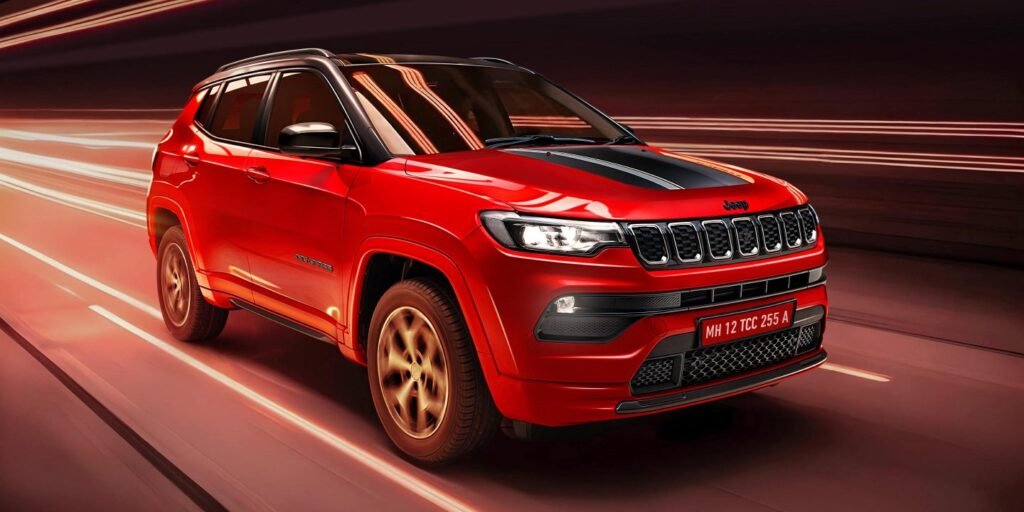
The Jeep Compass is off-road capable yet premium. It certainly looks modern, but its broad proportions lend it a touch of old-school design charm, reinforcing its identity as a true SUV rather than just a crossover. Up front, highlights include a wide black band stretching from one headlight to the other—incorporating a modern take on Jeep’s iconic seven-slot (chrome-lined) grille. According to Jeep’s lead designer Mark Allen, the headlamps feature a white accent that helps them stand out. They also house LED guide lights—though these are not the DRLs; the actual DRLs are positioned on the bumper, just above the fog lamps. The clamshell hood is sculpted.
The Jeep logo sits on the bonnet, just above the grille. A small, horizontal, slat-style grille on the painted section of the bumper helps break up the large expanse between the main grille and the air dam, while also effectively channeling air toward the radiator. The air dam is as wide as the main grille and adds visual cohesion to the front end, with a chrome lip at its base providing a touch of bling.
| DIMENSIONS & WEIGHT | |
| Overall Length | 4395 mm |
| Overall Width | 1818 mm |
| Overall Height | 1640 mm |
| Wheelbase | 2636 mm |
| Ground Clearance | 205 mm |
| Kerb Weight | 1562 kg |
The signature Jeep trapezoidal wheel arches house 17-inch silver alloy wheels shod with Firestone 225/60 all-weather tires. If you desire larger wheels, the Compass Limited Plus comes with a set of 18-inch dual-tone wheels that enhance the car’s road presence. Design details—such as the lines on the wheel arches and the prominent character line running from the door handles to the taillamps—make the compact SUV visually exciting. Prominent ‘Compass’ badges are affixed to both front doors.
The design’s crowning jewel is the chrome line separating the contrast-painted roof from the rest of the body; this line runs from one ORVM (Outside Rear-View Mirror) above the windows, sweeps down towards the rear, and continues along the windows on the opposite side to terminate at the other ORVM. The roofline appears to flow towards the rear while the window line rises, featuring a kink at the very end that—according to Jeep—resembles a shark fin. The roof rails and spoiler are understated, but the standout feature is the panoramic sunroof, offered exclusively on the Compass Limited Plus. Beyond its convenience, this feature lends the SUV a more upmarket appeal.
At the rear, the Compass features a distinctive design. Key highlights include a wraparound rear windshield with a chrome line running along its base, split tail-lamps featuring prominent LED guide lights (mimicking the units found in the headlamps), a slightly recessed license plate holder, and a two-part bumper with integrated fog lamps. The Jeep logo sits prominently just below the windshield—a unique touch.
Take a look all around, and the Jeep Compass feels solid; panel gaps are consistent, and the paint quality is impressive. The Jeep Compass is offered in five color options: Exotic Red, Brilliant Black, Minimal Grey, Vocal White, and Hydro Blue (the color of the car seen in the photos).
Jeep Compass Interior –
Unlock the Compass using the sensor on the front door handle, pull the handle to open the door wide, and you are welcomed by a dual-tone cabin. The black and off-white interior is inviting, though the lighter-colored sections are prone to getting soiled easily. Prior to the initial launch, Jeep officials had also showcased a Compass cabin featuring a sporty all-black theme with red inserts/highlights. Many expected this to be offered with the Compass Limited Plus, but for now, that cabin theme is off the table. However, we might see it in the Trailhawk variant.
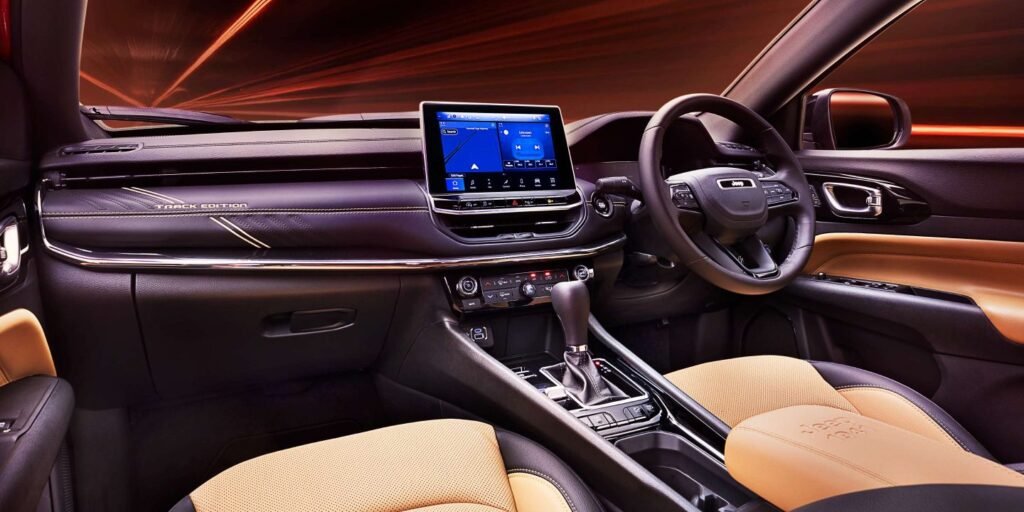
Survey the dashboard from the firm yet comfortable seats, and you will notice that the layout is slightly driver-focused. Most interior surfaces feature soft-touch materials—including the dashboard, door armrests, center armrest, and floor-mounted center console. The buttons—whether for the power windows on the door pads, the multi-function controls on the steering wheel, or the climate control system—feel premium and soft to the touch.
The cluster positioned below the touchscreen houses dials and buttons for controlling the infotainment system and dual-zone climate control, though the layout appears somewhat cluttered. Further down the center console, the Compass features USB and Aux-in ports, a charging port, and a rotary knob to control the ‘Selec-Terrain’ traction modes.
At first glance, clear signs of cost-cutting included a 7-inch infotainment screen, dummy buttons on the steering wheel, and a manual interior rearview mirror. However, Jeep has addressed two of these three issues with its new top-end variant. While a larger 8.4-inch unit was initially available only in international markets, this larger screen has now been introduced in the range-topping Compass Limited Plus. An auto-dimming interior rearview mirror is also available for the Compass. Unfortunately, these upgrades are offered only on the top-end model.
The system feels sluggish. We tested the built-in infotainment system and Android Auto, and the results were mixed; while it worked perfectly at times—responding to voice commands, reading out WhatsApp messages, etc.—at other times, it refused to respond even to simple requests via the touchscreen. This was the experience shared by everyone in the car during a long, three-hour drive.
The on-screen icons could have been larger for better usability. In addition to standard connectivity options like FM/AM, USB, Aux-in, and Bluetooth, the system supports Android Auto and Apple CarPlay. It operates through a six-speaker setup that sounds good, and adjusting the equalizer settings noticeably alters the sound quality.
Getting into the Compass is easy, thanks to the wide-opening doors; once inside, the front bucket seats feel great—they are firm yet comfortable and wide enough to accommodate larger frames. The thigh support is particularly impressive. The driver’s seat is height-adjustable as well. While seats in other variants are manually adjustable, the Compass Limited Plus offers an 8-way power-adjustable seat with 4-way power lumbar support and a memory function.
The steering wheel is adjustable for both reach and rake; the chunky, leather-wrapped rim feels good to hold, and the thumb contours are well-designed. There are blanked-out buttons on the right side of this three-spoke unit. These spaces could have been utilized for infotainment controls; instead, the volume and mode buttons are positioned behind the steering wheel—a location you wouldn’t discover unless someone pointed it out to you!
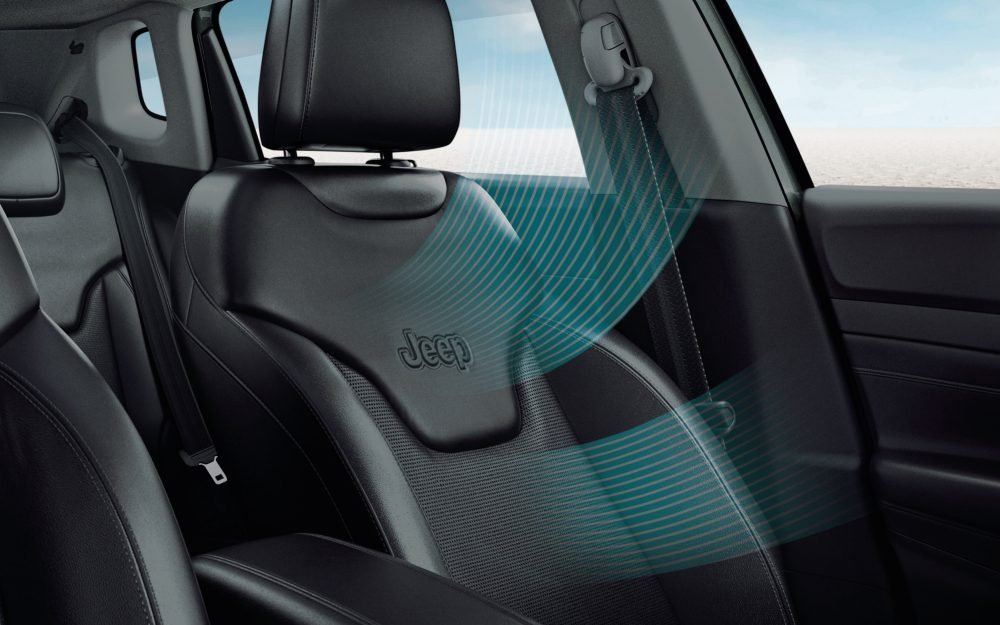
Move to the second-row seats, and you realize that the Compass is essentially a four-seater SUV. It doesn’t feel spacious enough to accommodate three adults comfortably on long journeys—the middle passenger misses out on a three-point seatbelt and a headrest, and has to contend with a large central hump that also houses the A/C vents. There is enough cabin space for four six-footers to sit comfortably, with ample legroom, knee room, and headroom for all passengers.
For a car of this size, the boot space is quite average. At 438 liters, it fares better than the Hyundai Creta (402 liters) but falls well short of the Hyundai Tucson’s 530 liters.
Jeep Compass Performance –
The Jeep Compass is offered in India with two engine options: a 2.0-litre, 4-cylinder, turbocharged ‘MultiJet II’ diesel engine producing 173PS of maximum power and 350Nm of peak torque, and a 1.4-litre, 4-cylinder, turbocharged ‘MultiAir’ petrol engine generating 162PS of power and 250Nm of torque.
Currently, the diesel engine is available only with a 6-speed manual transmission, whereas the petrol engine is available with an optional 7-speed dual-clutch automatic transmission. A 4×2 drivetrain comes as standard, but the range-topping diesel Limited, Limited (O), and Limited Plus variants are also available with 4×4 capability.
We drove the Jeep Compass powered by the 2.0-litre diesel engine, paired with a six-speed manual transmission and Jeep’s Active Drive AWD system featuring ‘Selec-Terrain’ driving modes. The diesel engine operates with barely any noticeable vibration or noise—reflecting the effort put into creating a comfortable and premium cabin experience. The clutch action is surprisingly light for a transmission designed to handle high torque.
Going off line is easy, and you only need to move the imbalance to let off the accelerator. Long but definitely fun to use the slotting gearbox, the metal-finish like gear knob is gorgeous.
| ENGINE & TRANSMISSION | |
| Engine Displacement | 1368 cc |
| Transmission Type | Manual |
| Fuel Type | Petrol |
| Maximum Power | 160bhp@3750rpm |
| Maximum Torque | 250Nm@1750- 2500rpm |
| Engine Description | 1.4-Litre 4-Cyl Multiair |
| Gearbox | 6-Speed Manual |
| No. of Cylinders | 4 |
You can ride the wave of peak torque in the power band; in slow-moving traffic, there is no need to constantly work the gears, slip the clutch, or modulate the throttle to keep the Compass moving forward.
In our tests, the Compass Diesel 4×4 managed to accelerate from 30–80 km/h in 7.32 seconds and from 0–100 km/h in 10.03 seconds. Jeep claims fuel efficiency figures of 17.1 kmpl for the 4×2 diesel and 16.3 kmpl for the 4×4 diesel.
In our tests, it returned 11.07 kmpl in the city and 16.02 kmpl on the highway. This is just slightly higher than the figures for the Hyundai Tucson diesel automatic (10.79 kmpl in the city / 14.47 kmpl on the highway).
The Jeep Compass is offered with a 1.4-litre turbo-petrol engine that produces 163PS of power and 250Nm of torque. In the base-spec Compass Sport, it is available with a 6-speed manual gearbox, whereas in the top-spec Compass Limited variant, it is offered exclusively with a 7-speed DCT automatic transmission.
On the other hand, the in-city driving experience has been excellent. Power delivery is smooth and predictable, with no sudden spikes that might catch you off guard. It even manages a 0–100 km/h sprint in 9.67 seconds. However, while drivability isn’t an issue, the fuel efficiency is truly painful.
Jeep claims a figure of 14.1 kmpl for the Compass petrol automatic. The best we managed was 6.1 kmpl in the city (with light traffic) and 8.5 kmpl on the highway! The reason? In regular city traffic, it tends to hold lower gears up to higher RPMs (around 2000 rpm) unnecessarily, resulting in higher fuel consumption. On the highway, the transmission is very eager to downshift to pick up speed, but it quickly returns to 7th gear (for instance, after an overtaking maneuver).
Jeep Compass: Ride and Handling –
On Goa’s smooth roads, the Compass’s suspension struck a fine balance between comfort and handling. It features ‘Frequency Selective Damping,’ which adjusts suspension rates based on road conditions and driver inputs. While it does feel sharp over severe bumps, the SUV generally keeps occupants comfortable across most other surfaces.
The suspension seems tuned for comfortable high-speed cruising—there is a hint of bounce, though it never becomes uncomfortable—and driving through tight corners reveals just why the Compass is so popular.
The steering setup on the Compass is a revelation. It connects well with the front wheels; while there is almost no resistance from the steering system at parking speeds, it gains a reassuring weight as speed increases.
A brief drive on the beach also gave us a preview of how effective the ‘Selec-Terrain’ system is. Controlled via a rotary knob on the lower center console, it offers shift-on-the-fly traction modes, including ‘Auto’, ‘Snow’, ‘Sand’, and ‘Mud’. Although the Compass is equipped with all-weather tires—which are usually just about adequate for handling varied terrain—the AWD system ensured the vehicle felt at ease on the soft sand.
Put to the test on a 3.5 km off-road track, the Jeep Compass felt like it was built for exactly this kind of terrain. Water crossings, deep undulations, slush tracks, slippery grass, wet rocky patches, and extremely rugged paths were all conquered with minimal effort. We tackled these obstacles using ‘Mud’ mode, which locks the 4×4 system and disables traction control.
The short first gear compensates for the absence of a dedicated crawler gear, providing enough grunt at the low end of the power band so you don’t need to slip the clutch to scale steep obstacles. The steering deserves a special mention here, too—it offered enough feedback for me to know exactly where the front wheels were pointing without tiring out my arms.
Jeep Compass Safety –
The Jeep Compass comes with an extensive list of standard safety features. These include Anti-lock Braking System (ABS), Electronic Brake-force Distribution (EBD), Electronic Stability Control (ESP), Traction Control, Hill Start Assist, and Panic Brake Assist (PBA)—which applies maximum braking pressure if the driver brakes suddenly in an emergency.
It also features Electronic Brake Prefill (which slightly engages the brakes if the system detects the driver suddenly lifting off the accelerator, ensuring no delay in braking performance), Electronic Rollover Mitigation (using a combination of brakes, traction control, and engine torque control to prevent the car from rolling over during extremely sharp turns), and dual front airbags across all variants.
While 4x4 variants get a total of six airbags, even the top-spec 4x2 Compass makes do with just dual front airbags. This is hard to accept when you consider the on-road price exceeding ₹20 lakh.
Other safety features—such as cornering fog lamps, a rear-view camera with a display on the infotainment screen, rear parking sensors, and manually dimming IRVMs—also enhance the sense of safety. While Jeep initially omitted safety tech like auto-dimming IRVMs, automatic headlamps, and automatic wipers, this has been rectified with the introduction of these features in the ‘Limited Plus’ variant.
Jeep Compass Variants –
The Jeep Compass is offered in four variants: Sport, Longitude, Limited, and the top-spec Limited Plus. The diesel variant is powered by the 2.0-litre ‘Multijet II’ engine, which is now paired exclusively with a 6-speed manual transmission. The petrol Compass, powered by the 1.4-litre ‘MultiAir’ engine, comes with a 6-speed manual gearbox as standard, though the range-topping version is offered exclusively with a 7-speed dual-clutch automatic transmission. The 4×4 system is available only on the top-of-the-line Limited/Limited (O) variants powered by the 2.0-litre diesel engine.