Hyundai Verna Review –
With a combined market share of nearly 80 percent, it is evident that the Maruti Ciaz and Honda City are the dominant players in the C-segment (mid-size sedan category). However, the new Hyundai Verna is proving to be a formidable challenger. Notably, the new Hyundai Verna is longer, larger, and more attractive than its predecessor. The pricing is well-structured, ranging from ₹11 lakh for the base model to ₹18.39 lakh for the top-end variant.
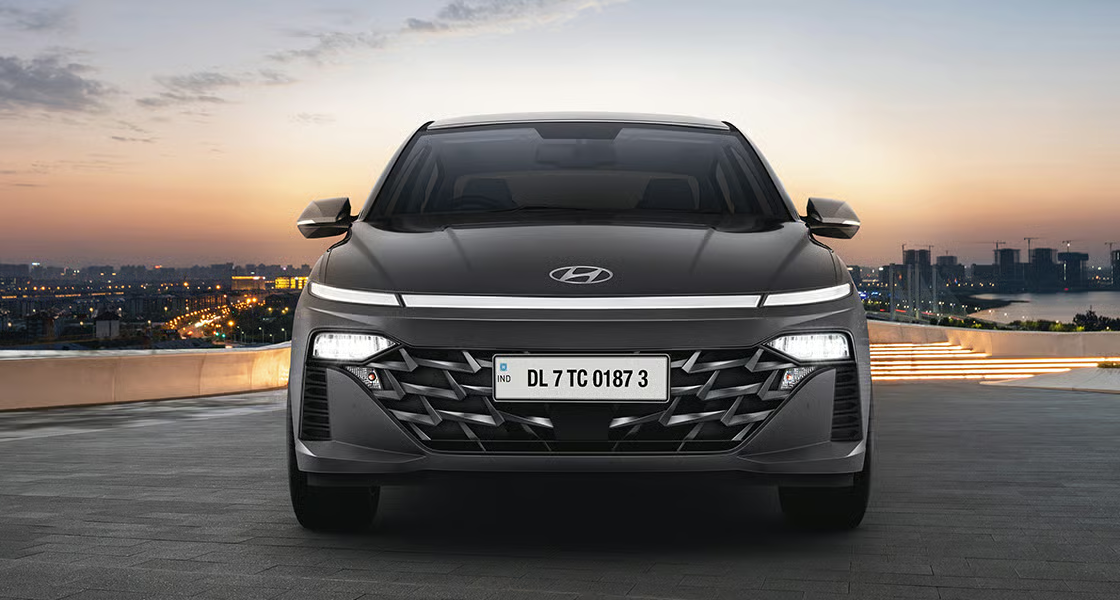
The story is quite different on the inside as well. In particular, the all-new architecture underpinning the 2026 Hyundai Verna’s striking design promises to address one of our major criticisms—agility.
The new Hyundai Verna is competitively priced, ranging from ₹11 lakh for the base model to ₹18.39 lakh for the top-end variant; this aligns with the pricing of the diesel Maruti Ciaz and significantly undercuts the Honda City. Its feature set is likely to attract a wide audience, boasting segment-first additions such as a hands-free boot lid and ventilated front seats, alongside an electric sunroof. In this new avatar, Hyundai has brought a fresh sense of maturity to the Verna’s design.
The new model strikes an excellent balance between handling and ride quality, resolving a key issue we had with the previous version. A three-year/unlimited-kilometer warranty further makes it a sensible purchase. A significant drawback of the new Verna is the lack of rear-seat space, making it far from ideal for users who intend to spend most of their time in the back; nevertheless, the 2026 Hyundai Verna is well-positioned to draw mid-size sedan buyers to Hyundai showrooms.
Hyundai Verna Exterior –
| DIMENSIONS & WEIGHT | |
| Overall Length | 4440 mm |
| Overall Width | 1729 mm |
| Overall Height | 1475 mm |
| Wheelbase | 2600 mm |
| Ground Clearance | 165 mm |
| Kerb Weight | 1170 kg |
This design is not new to the public; it first saw the light of day when it was unveiled in China. In fact, it is already on sale in Russia under the Solaris badge. For the Indian market, the Verna features projector headlamps with LED daytime running lights and projector fog lamps flanking the new, larger front grille.
The car’s side profile is reminiscent of another model from the company, the Hyundai Elantra; this is because the two cars share the same platform. Consequently, apart from looking more mature, it is slightly larger than the outgoing model. The length has increased to 4,440 mm—an addition of 65 mm—while the width has grown by 29 mm to 1,729 mm, and the wheelbase has extended by 30 mm to 2,600 mm. However, despite the sharply raked roofline, the height remains unchanged at 1,475 mm.
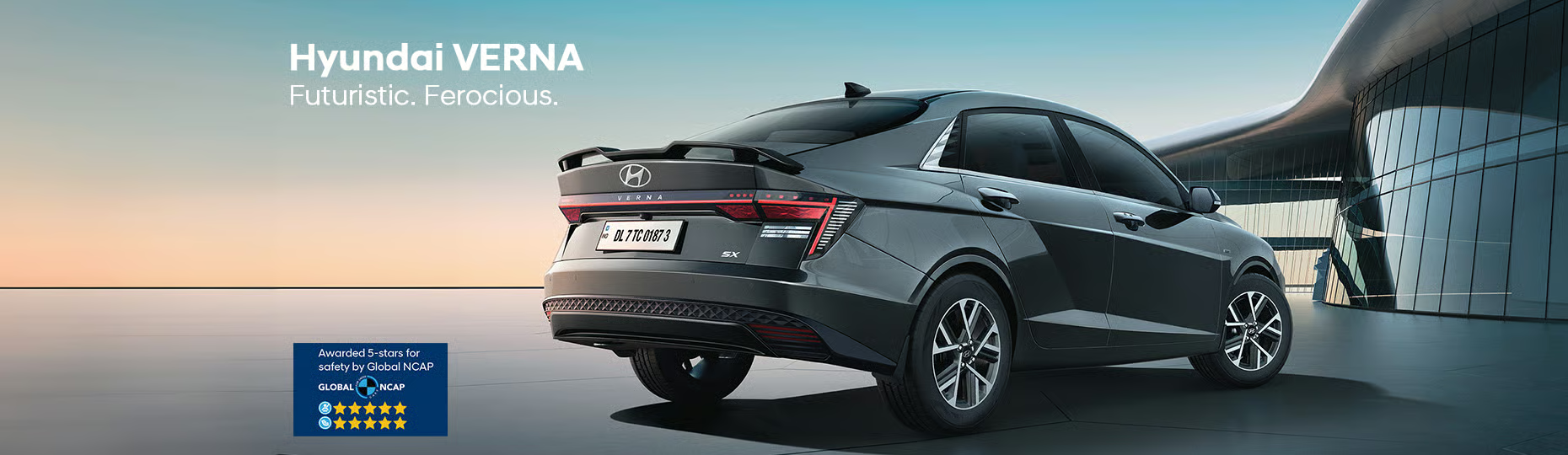
The roof slopes gently towards the rear of the car, creating a profile that almost resembles a notchback. The tail lights are similar to the Elantra’s, featuring a three-unit design; however, while the Elantra uses round LED elements, the new Verna Sport sports semi-circular units. A chunky bumper flare rounds off the car’s mature new look.
Hyundai Verna Interior –
Cabin Seats And Dashboard –
| CAPACITY | |
| Seating Capacity | 5 |
| Number of Seating Rows | 2 Rows |
| Number of Doors | 5 Doors |
| Boot Space | 480 litres |
| Fuel Tank Capacity | 45 litres |
The interiors of the Hyundai Verna were always one of its strong points and the new car carries on the same levels of quality in materials and plastics. However the design is very similar to what we have seen on other new Hyundais, so it lacks any innovation and is a bit underwhelming for a new car. Compare it to the old Verna and the design looks a bit flashy and bold. Additionally, the switches on both the dash and steering wheels have very positive functions and feel solid and well built.
The central console has a large 7-inch touchscreen display paired with buttons for different functions and this makes the experience in the 2017 Verna more immersive and less distracting than the all-touch-based system like in the Maruti Ciaz for example.
The front seats have a good soft cushioning with good lumbar and lateral support. The seats could have been a little taller to offer a little better support. As it stands they are not incapable, but we would have liked a little more support. The legroom in the front is really good for the front seats.
The Verna 2026 is also the first car in the segment to offer air-cooled seats; surprisingly, despite the increase in dimensions, there hasn’t been a significant increase in rear-seat space.
There is adequate legroom for full-sized adults, though seating three abreast would be a bit of a squeeze. It is nowhere near as spacious as the Maruti Ciaz or Honda City.
Technology, Features, and Safety –
The top-end versions are equipped with everything from navigation to smartphone connectivity features like Android Auto, Apple CarPlay, and MirrorLink. Keeping segment trends in mind, the new Verna now features an electric sunroof and introduces a segment-first hands-free boot lid that opens if you stand within three feet of it for three seconds with the key in your pocket.
It also includes a reverse parking camera and parking sensors; however, it misses out on all-LED headlamps and rain-sensing wipers—features that are available in the Honda City. The top-end variant of the Hyundai Verna continues to offer six airbags, while dual airbags and ABS are standard across the range.
Another thoughtful feature is the ‘Hyundai Auto Link’ app, which comes as standard on the top-end SX(O) variant. This app was developed at Hyundai’s R&D center in Hyderabad. It connects the car to your smartphone and provides comprehensive vehicle information—ranging from real-time data to details like engine speed, engine load, and braking habits—all accessible from the comfort of your home. Additionally, it allows you to book services, check your driving history, and even save your last parking location.
Hyundai Verna Performance –
The Verna now comes with only two engine options—petrol and diesel—and both are more powerful 1.6-litre engines. The VTVT petrol engine generates 123PS of power and 151Nm of torque, while the CRDi diesel produces 128PS and 260Nm of torque. Both manual and automatic transmissions are available with these engines, and to ensure better refinement and efficiency, both are 6-speed units.
Hyundai Verna Diesel Car –
The 1.6 CRDi engine of the 2026 Hyundai Verna is just as powerful as that of the outgoing model, but it now delivers more torque at lower RPMs. This means that even at low city speeds of around 30 kmph, you can stay in third gear, and the car will pull away cleanly when you press the accelerator. There is a gentle surge in acceleration when the turbo kicks in at around 1700–1800 rpm, yet the engine doesn’t feel sluggish below that point either.
| ENGINE & TRANSMISSION | |
| Engine Displacement | 1582 cc |
| Transmission Type | Manual |
| Fuel Type | Diesel |
| Maximum Power | 128 HP @ 4000 rpm |
| Maximum Torque | 260 NM @ 1500-3000 rpm |
| Engine Description | 1.6L, DOHC CRDi |
| Gearbox | 6-Speed Manual Gearbox |
| No. of Cylinders | 4 |
| Alternator Management System (AMS) | |
It is a bit rorty, however, and quite audible inside the cabin between 1,100 and 1,800 rpm—from idle up to medium throttle inputs.
Across the rest of the rev range, the engine settles into a much quieter note. Hyundai claims the diesel Verna should return 24.75 kmpl with the manual transmission and 21.02 kmpl with the automatic gearbox. The previous-generation Hyundai Verna was rated at 23.9 kmpl for the manual and 19.08 kmpl for the automatic.
Hyundai Verna Petrol –
The 123PS petrol Verna is undoubtedly the quieter of the two, and given that it is tuned for better city drivability, it doesn’t feel rushed. If you are in the mood for a calm and composed drive, it rewards you with smooth progress, thanks to its 151Nm of torque, a significant portion of which is available from as low as 1500rpm. In fact, with the 6-speed manual transmission, we were able to pull away in sixth gear from speeds below 25 kmph (albeit very gently) without any protest from the engine or transmission.
If you need to make quick progress—for instance, when we had to return the car to the hotel before the buffet closed—you need to keep the petrol engine spinning between 3500 and 5000rpm, which is its sweet spot. Hyundai claims a fuel efficiency of 17.7 kmpl for the manual and 15.92 kmpl for the automatic petrol version. These figures are slightly higher than the 17.01 kmpl (manual) and 15.74 kmpl (previous 4-speed auto) of the Verna 4S.
Automatic Gearbox –
We didn’t get a chance to drive the diesel manual version of the 2026 Verna, but the 6-speed conventional torque converter automatic transmission was a pleasant surprise. Torque converter transmissions used to be dubbed “slush boxes” due to their sluggish response and a disconnected feel at the throttle pedal. However, I really liked this Hyundai unit; it is responsive and quick, feeling very direct and connected while driving in the city with light to moderate throttle inputs.
Handling and Ride Quality –
A major drawback of the older Hyundai Verna was that it wasn’t a car suited for high-speed driving. With the new K2 platform and revisions to both the front and rear suspension setups, Hyundai has completely transformed the driving experience in the 2025 Verna. The steering remains quite light in the city—making navigating Kochi’s tight, traffic-congested roads a breeze—while gaining a reassuring weight as speeds increase on the highway. The steering also feels quite direct, effectively keeping you connected to what is happening at the front wheels.
| PERFORMANCE & MILEAGE | |
| Mileage (ARAI) | 24.75 kmpl |
| Top Speed (KMPH) | 190 KMPH |
| Mileage (City) | 18 kmpl (approx.) |
| Mileage (Highway) | 21 kmpl (approx.) |
It handles very well around corners, too. The chassis remains quite flat; while there is some body roll when pushed hard, it always feels predictable and controlled. The brake pedal is quite firm—and although the braking is very linear and offers ample stopping power—we would have preferred it to be slightly lighter.
The ride quality of the new Verna remains excellent, as comfort hasn’t been compromised. It leans towards the firmer side but still absorbs road bumps and imperfections effectively. This is a credit to Hyundai, which has put a lot of work into the suspension.
Hyundai Verna Security –
| ACTIVE & PASSIVE SAFETY FEATURES | |
| Front Seatbelt Pre-Tensioner | yes |
| Clutch Lock System | yes |
| Airbags | Driver & Passenger |
| Rear View Camera | yes |
| Self Locking Doors | yes |
| Seatbelt Reminder | yes |
| Parking Sensors | yes |
| Height Adjustable Front Seat Belts | yes |

Your point of view caught my eye and was very interesting. Thanks. I have a question for you.