Why Would I Buy It?
- Few cars at this price make driving this enjoyable. The 1.5-litre TSI, the chassis and the steering work together very well.
- The ride is comfortable, and 179mm of ground clearance means you rarely have to slow down for speed breakers.
Why Would I Avoid It?
- There is no ADAS and no rear sunshades. The 1.5 TSI is DSG-only, with no manual option.
- Turbo lag combined with the DSG’s response makes quick getaways feel slower than the power figures suggest. Fuel efficiency is poor when you drive it hard.
Introduction
The Slavia has been one of the most fun sedans on sale for a while, and the facelift does not try to change that. Skoda has kept the mechanical package largely as it was and spent its effort on styling, equipment and the cabin. It is a sensible approach, since the car was never short of driving appeal.
I spent my time with the 1.5 TSI Monte Carlo, the most enthusiast-focused version of the range. Skoda unveiled the facelift on August 18, and it comes in six variants: Classic, Classic Plus, Signature, Sportline, Prestige and Monte Carlo. Official prices had not been announced at the time of writing.
Exterior Design
8 / 10
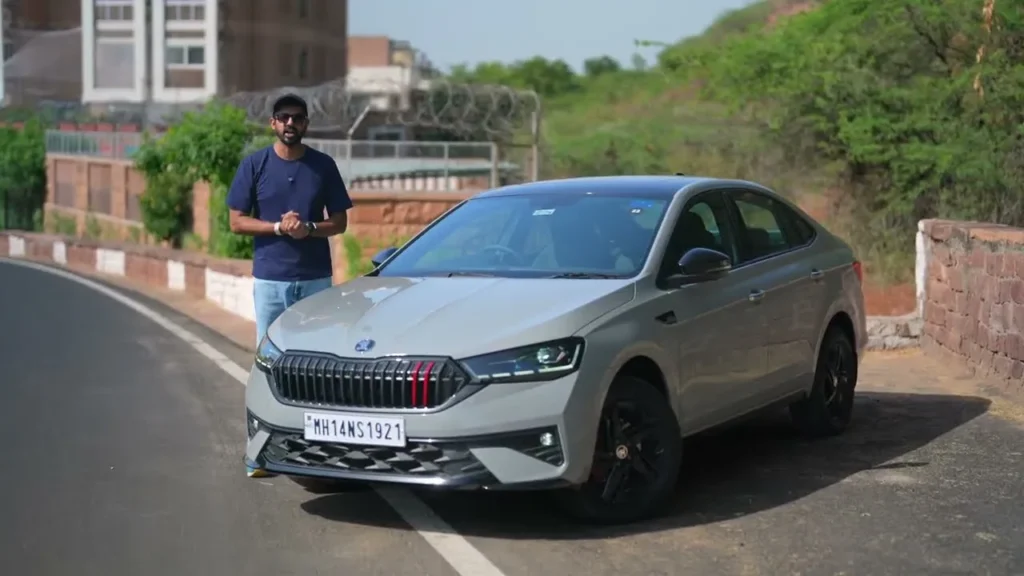
The silhouette is unchanged, which suits me, because the Slavia’s proportions were never the problem. What you get is a set of fresh details. There are new full-LED headlamps, a redesigned grille and a new front bumper that now houses front parking sensors. The fog lamps are LED units, the alloy wheels are new, and the tail lamps get sequential turn indicators.
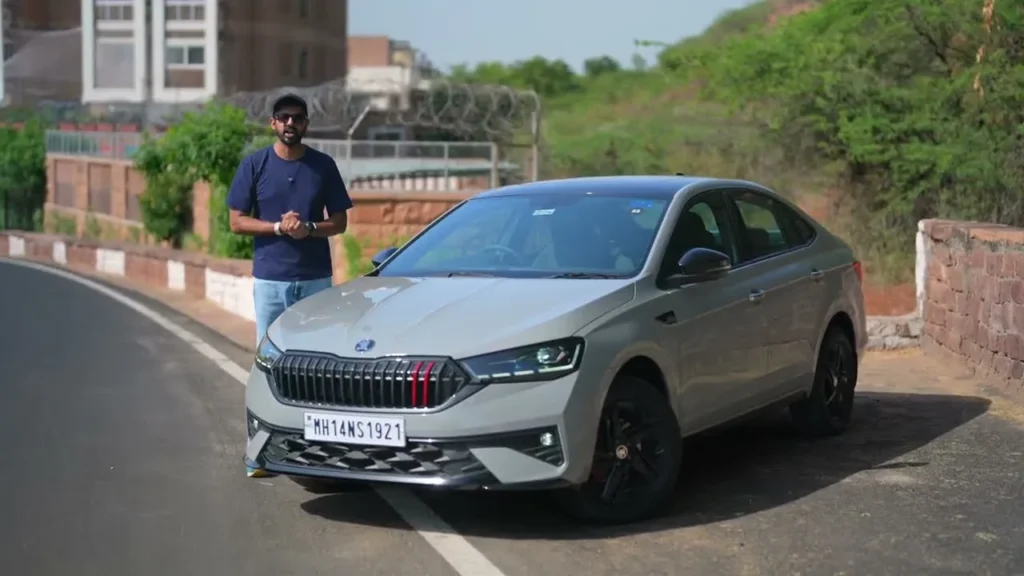
The Monte Carlo is where the facelift looks best. Gloss black is used on the front bumper, mirror caps, roof, shark-fin antenna, window surrounds, the lower door area, a small rear spoiler and the rear bumper. The black alloys carry red brake calipers on all four wheels, and the grille has red inserts with Monte Carlo branding. More Monte Carlo badges sit on the front fenders and the tailgate, and Skoda lettering runs between the tail lamps. It looks sporty without being loud.
Interior Design
8 / 10
The cabin is finished in black, with red inserts and red stitching on the seats. The dashboard has a red-toned panel, though to my eye it leans closer to maroon. Monte Carlo badges appear on the headrests, apart from the centre rear seat, which does not get one. The front door scuff plates also carry the name.
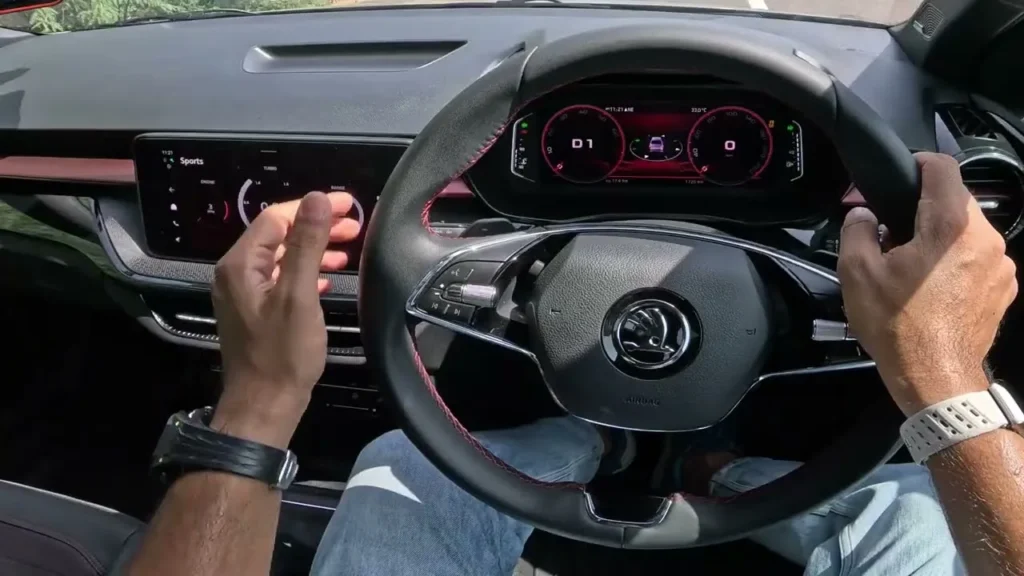
The biggest change is the instrument cluster, which grows from 8 inches to 10.25 inches and looks far better for it. The Monte Carlo has its own display theme with a red backdrop. A new menu shows performance data such as turbo behaviour. There is also an off-road data page, which makes little sense on a sedan, though it is entertaining.
Features
8.5 / 10
The equipment list is a clear step up. The cluster now supports turn-by-turn navigation, and the 10-inch infotainment system has been updated and is noticeably better to use. A 360-degree camera is new, and it helped a lot on narrow roads when another vehicle refused to give way. The headline addition is a rear seat massager, which Skoda positions as a first in the segment.
The gaps are easy to list. There is no ADAS, rear sunshades are missing, and the horn sounds weak for a car with this character. I would also like to see selectable drive modes, which the car does not offer.
Performance
9 / 10
The 1.5-litre TSI makes 150PS and 250Nm, and it is the reason to buy this car. It pulls hard, revs freely and sounds good near the top end. The engine can shut down two of its four cylinders under light load to save fuel. In my driving it never felt like a compromise, and it made me forget diesel engines.
It does have one clear flaw. Turbo lag, along with the DSG’s delayed response from a standstill, takes away some of the punch when you want to get going quickly. The gearbox also changes up at around 6,200rpm, even in manual mode with the paddles, so you cannot hold a gear to the limiter. Launching the car with traction control off does not produce the drama you might expect, because the gearbox limits it. Once the car is moving, it is quick. Both engines are electronically limited to 204km/h.
On acceleration, my informal 0-100km/h runs gave 8.99 seconds on a slight slope with a heat-soaked engine. An earlier drive had given me around 8.5 seconds. Treat these as indicative, not as instrumented figures.
Mechanical changes are limited. The one that matters is on the 1.0 TSI, which now has an 8-speed torque converter automatic with two extra ratios. Its output is 115PS and 178Nm. You can feel its three-cylinder nature at idle, but it is refined. I think the gearing could be revisited, as it feels short on the 1.0 and tall on the 1.5. The 1.0 is the engine most buyers will pick, and it is good. If your budget allows, the 1.5 is the one to get, because the difference in performance is big.
Ride and Handling
9 / 10
This is where the Slavia stands apart from rivals. The suspension is beautifully tuned and soaks up bad roads while the car stays composed at speed. At around 1,270kg on the MQB A0-IN platform, it feels light, agile and well balanced. Body control is excellent, and the steering is light at low speeds but weighs up nicely and has good feedback. Braking is strong and consistent.
When pushed hard in corners, the front tyres run out of grip before the chassis does, and I noticed some understeer. The chassis can clearly take more than the tyres allow. The ground clearance is the cherry on top, as I could take speed breakers without worry. The car manages to ride well and handle well while staying high enough for Indian roads.
In the city, it is easy to live with. Once you are past the turbo lag, the engine is smooth and quiet.
Running Costs and Ownership
Do not expect economy if you drive it as I did. I saw around 6-7km/l when pushing hard, and I would expect 10-12km/l with calm driving. The 1.0 TSI is better for efficiency. The fuel tank is 45 litres.
Skoda offers a 4-year / 1 lakh km warranty that can be extended by 2 years, along with a 6-year anti-corrosion warranty and a 3-year paint warranty. Its Surakshaa ownership package includes 4 years of service and roadside assistance. Skoda has also added more colours to the range.
Verdict
8.5 / 10
The Slavia facelift remains one of the best arguments for buying a sedan instead of an SUV. It rides well, handles superbly and now has a better-equipped cabin, while the 179mm ground clearance keeps it practical. The 1.5 TSI Monte Carlo is the most rewarding version, though the turbo lag, the lack of a manual and the missing ADAS stop it from being perfect.
I would have liked a few more mechanical updates, such as stiffer suspension, a sportier exhaust or an RS version, because the chassis and engine deserve it. Pricing is the open question, since Skoda had not announced prices yet. The earlier Slavia was sold at roughly Rs 10 lakh to Rs 18.29 lakh (ex-showroom), and prices are likely to rise somewhat. Rivals include the Volkswagen Virtus, Hyundai Verna and Honda City. If driving pleasure is your priority, take a test drive of the Slavia before you decide.Which would you pick, the 1.0 TSI or the 1.5 TSI? Tell us in the comments.
