Suzuki has laid out an ambitious technology roadmap through its Technology Strategy 2026 briefing, covering everything from lighter vehicle construction and a new turbo-petrol engine to drastically faster car development and a plug-in range-extender hybrid. Together, these initiatives could reshape future Maruti Suzuki cars in India — from more efficient hatchbacks to CNG models with far less weight penalty.
Here’s a complete breakdown of everything Suzuki has confirmed.
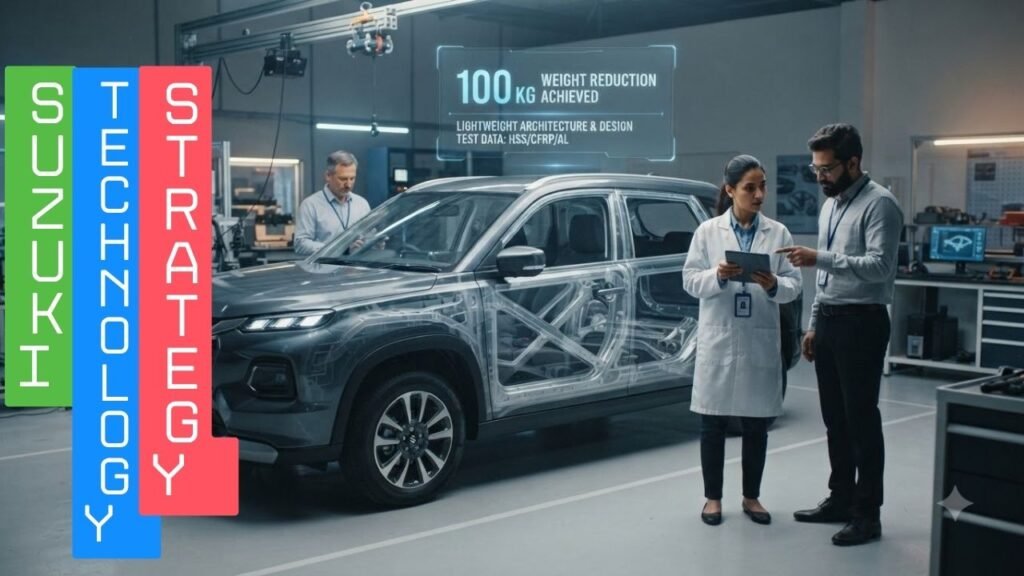
Suzuki Targets 100 Kg Weight Reduction By 2030 –
Suzuki has outlined a lightweight engineering programme aimed at cutting up to 100 kg — potentially 120 kg — from vehicle weight by 2030. Rather than one big change, the company is targeting savings across the entire car:
- Vehicle architecture, powertrains and electrical systems
- Optimised deformation space by repositioning components such as the engine
- Increased use of high-tensile steel for thinner yet strong sections
- Even bolt heads are being redesigned — shrinking an M8 bolt head saves about 1 gram, which adds up given a car uses 2,000+ bolts
Suzuki says the goal is to reduce weight without compromising crash safety, by carefully managing how crash energy travels through the vehicle structure rather than simply adding reinforcement.
Lighter CNG Cylinders: A Big Deal For India –
One of the most India-relevant parts of this plan is a lighter CNG cylinder. Suzuki wants to replace the current ~60 kg steel cylinder with a resin cylinder weighing around 20 kg — a saving of roughly 40 kg. This could make future Maruti CNG cars noticeably less compromised on weight and boot space, though the first model, cylinder capacity and timeline remain unannounced.
Suzuki is also studying a mono-fuel, CNG-only vehicle (unlike today’s petrol-plus-CNG setup), though this too remains at the study stage with no confirmed production plans.
Suzuki Wants To Develop New Cars In Just 24 Months –
Alongside lighter vehicles, Suzuki is targeting a massive cut in development time — from the current 40-48 months down to roughly 24 months by the end of the decade. Suzuki president Toshihiro Suzuki has pointed to the pace of Chinese automakers as a benchmark the company can no longer ignore.
Key elements of this plan include –
Concurrent development —
Planning, design, production engineering, quality and procurement will work in parallel instead of in sequence
Deeper digital engineering —
More design standards and evaluation work moved into digital development
Greater modularisation —
Sharing common systems and components across multiple models
A targeted 50 percent improvement in production efficiency versus Suzuki’s Manesar plant benchmark.
This builds on an earlier, more modest Maruti Suzuki plan reported in June to cut development cycles from 48 months to 36 months across a pipeline of nine new models — seven of them SUVs. A global 24-month target would represent a far bigger leap if fully adopted for future Maruti programmes.
Suzuki has confirmed that India will remain one of its two core pillars, alongside Japan, for both development and manufacturing — with India also targeted to reach an annual production capacity of about four million vehicles from FY2030.
New DITC Turbo-Petrol Engine For India –
Suzuki is also developing a new-generation direct-injection turbo-petrol engine, internally called DITC (Direct Injection Turbo Charged), aimed specifically at growth markets including India. No displacement, power, torque or launch timeline has been confirmed yet.
- Designed to boost both performance and fuel efficiency, unlike conventional turbo engines built mainly for power
- Could offer flexibility across Maruti Suzuki’s range, from hatchbacks to midsize SUVs
- Unclear whether it will replace or sit alongside the existing 1.0-litre Boosterjet engine, currently seen on the Fronx and the recently launched turbo-petrol Brezza
Maruti previously offered turbo-petrol power via the Baleno RS (2017), which was discontinued before BS6 norms kicked in, before turbo technology returned with the Fronx and Brezza.
Suzuki Aims For 50 Percent Thermal Efficiency –
Beyond the new engine itself, Suzuki is working to push thermal efficiency — how effectively an engine converts fuel into usable power — from around 40 percent today (on its Z12E engine) to closer to 50 percent. Technologies under consideration include:
- Lean combustion and higher compression ratios
- Increased exhaust-gas recirculation and faster combustion
- Miller cycle and waste-heat recovery systems
- Lower-viscosity lubricants and reduced mechanical losses
Suzuki has clarified this 50 percent figure is a broader R&D target for combustion-engine technology, not a confirmed spec for the DITC engine specifically.
REEV Light: Plug-In Range-Extender Hybrid For Compact Cars –
Suzuki has also confirmed development of a plug-in range-extender system called “REEV Light” for compact cars, evolving from its in-house series-hybrid programme.
- Uses an electric motor to drive the wheels, with the engine acting purely as a generator
- Adds a charging port and a “right-sized” battery, so owners can plug in for short trips or rely on the engine-generator for longer journeys
- Suzuki says the approach avoids an oversized, costly battery pack while still removing range anxiety
- The 1.2-litre, three-cylinder Z12E engine has been linked to this programme as a possible generator unit, with the Fronx and Baleno previously identified as candidate models — though Suzuki hasn’t confirmed the exact vehicle or engine pairing for REEV Light
Suzuki estimates its related compact-car series hybrid could cut CO₂ emissions by around 29 percent (roughly 300 kg over 10,000 km) versus its 2022 baseline, though a specific figure for REEV Light hasn’t been released yet.
Why This Matters For India –
India sits at the centre of Suzuki’s strategy — as a manufacturing base, an export hub, and a market where fuel diversity (petrol, CNG, hybrids, flex-fuel and EVs) is only growing more complex. Faster development cycles, lighter vehicles, a new turbo engine and plug-in hybrid tech are all aimed at helping Maruti Suzuki respond quicker to shifting demand without compromising on safety, cost or reliability.
Our Take –
Suzuki’s Technology Strategy 2026 is less about a single flashy product and more about rebuilding the entire playbook — how fast cars get made, how light they can be, and how many powertrain options can coexist without ballooning costs. The 100 kg weight cut and lighter CNG cylinder are the pieces Indian buyers will feel most directly, while the 24-month development target could be what lets Maruti Suzuki actually keep up with a fast-moving, multi-powertrain product line-up. None of this is showroom-ready yet, but it’s a clear signal of where Maruti Suzuki’s next generation of cars is headed.
What excites you most — lighter CNG cars, the new turbo engine, or the plug-in hybrid? Let us know in the comments below!